Math practice kids love. Grades 1–4.
Most kids don't hate math. They hate feeling lost. Upcome turns frustration into understanding with the Concrete → Pictorial → Abstract method, a companion who makes mistakes alongside them, and a system built so every child succeeds at their own pace.
Nova's Counting Adventure
Maya, Age 6
Current Phase
Guided Practice: Number Bonds for 7
Session Streak
5 days
Mastery
85%
Real curriculum, grade by grade.
Finished grades show full units and lessons — not samples.
More grades and subjects on the way. Browse the full curriculum →
When a child feels lost in math, they don't ask for help.
They decide they're "bad at math." That belief hardens into avoidance, and avoidance becomes anxiety. Research links this pattern to math anxiety that can start early, affecting their memory, attention, and willingness to try.
The damage isn't caused by hard math: it's caused by how math is taught and how wrong answers are handled. Timed drills, red X's, score screens, public comparison. The usual toolkit makes it worse.
Upcome interrupts that pattern before it sets. Every design decision is chosen to build a child who believes they are a math person. That belief, formed early, is what keeps them trying.
Timed math drills
Time pressure is a top trigger of math anxiety in young children
Red X on wrong answers
Punishing feedback activates threat response, suppresses learning
Leaderboards
Comparison to peers damages math identity
Stars/coins that gate content
Extrinsic rewards reduce intrinsic motivation
"You got X/10" mid-lesson
Score framing during learning increases anxiety
Generic praise ("Amazing!")
Cognitively empty: children learn to disregard it
Every lesson follows
the same five phases.
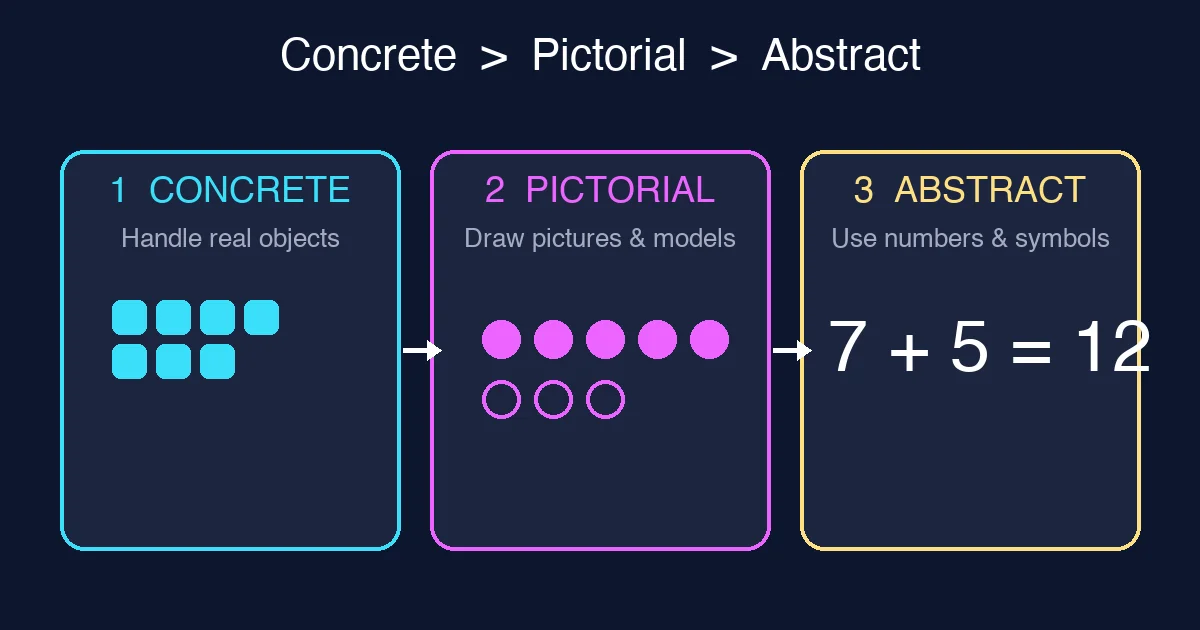
Here's how we break the cycle — in about 15 minutes a day. The CPA method (Concrete → Pictorial → Abstract) is the most evidence-backed sequence for teaching number to young children. No phase is optional. No phase is reordered.
Warm-Up
45–60s
Two quick questions — one reviewing a past skill, one on-topic. The child cannot fail the warm-up.
ConcreteConcept Intro
90–120s
Nova demonstrates the new idea with objects, then pictures. Zero questions — pure story. Nova always makes a mistake and fixes it.
Concrete → PictorialGuided Practice
90–120s
Three questions with a 3-level hint system always available. Nova coaches actively.
PictorialIndependent Practice
120–180s
Three questions with reduced support. Nova is present but quiet — the child builds fluency.
Pictorial → AbstractChallenge + Reflection
45–60s
Two real-world story questions, then: "What felt tricky? What are you proud of?"
Abstract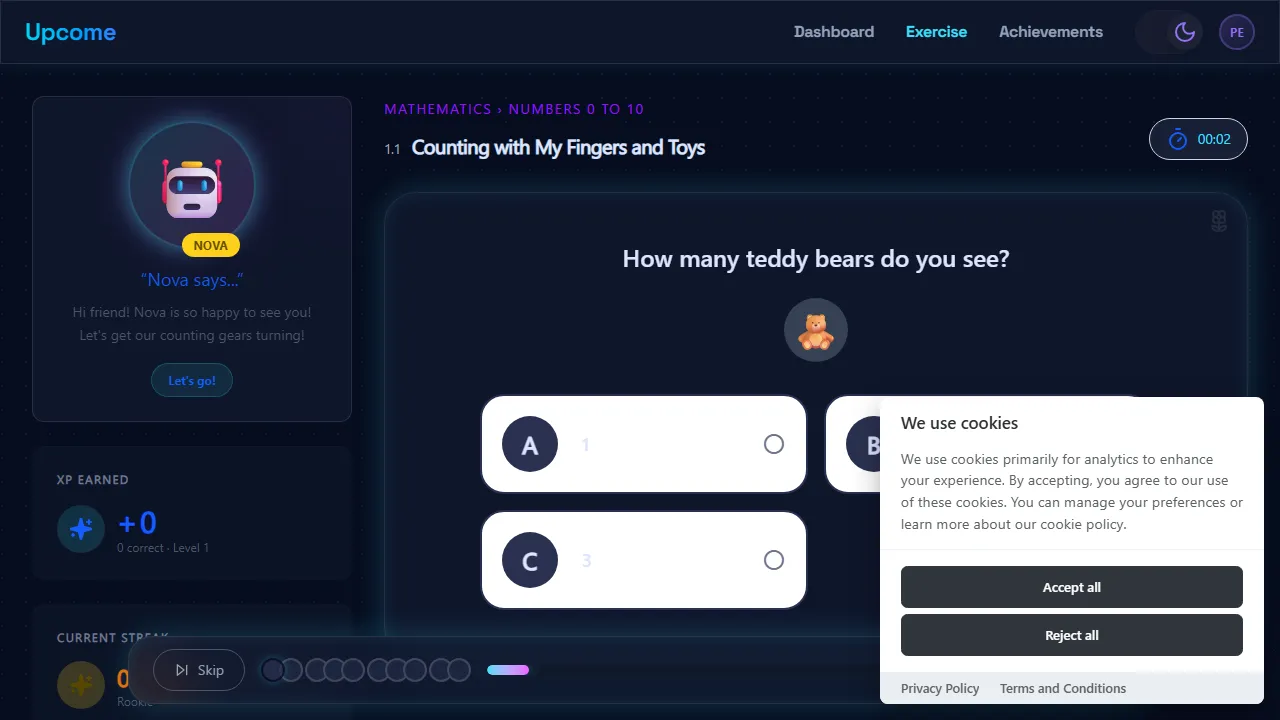
You're the most powerful learning partner.
We just show up.
Almost no parent was taught how to support early math learning without accidentally increasing anxiety. Our job is to make you feel capable and excited, not judged or overwhelmed.
Weekly Reports, Not Scores
Every Monday, get a warm email: what your child practiced, what they're getting good at, and one question to ask them. No percentages. No comparison to other children.
Together Time
When your child is stuck, Upcome offers optional 10-minute co-play sessions. Nova gives all instructions. You just sit alongside. No teaching required.
Plain-English Progress
Not "0.83 accuracy on cardinality tasks." Maya counted objects correctly in 5 of 6 tries this week. You always know what's happening.
How to Help Without Over-Helping
A one-page guide on the most common well-meaning mistakes parents make (jumping to the answer, expressing math anxiety) and concrete alternatives.
Frequently asked questions
What ages is Upcome for?
Upcome is built for kids in grades 1–4, starting with mathematics. A first taste of English Language Arts for Grade 1 is in early release, with more grades and subjects on the way.
How much does Upcome cost?
One flat price: $4.50 a month or $39.50 a year at 50% off launch pricing. It covers up to 3 children — no per-child fees, no trial to cancel, and you can cancel anytime.
How long is a daily session?
15 minutes a day. Lessons run 5–8 minutes each, so a session is usually two or three lessons — short enough to fit real routines, long enough to build the 'I finish math' habit.
What does my child see when they get something wrong?
No red X, no sad face, no buzzer. Nova responds warmly and immediately. 'Hmm, let me look at that again with you!', and redirects with a hint. The child always gets to try again and succeed on their own.
What is CPA?
CPA stands for Concrete → Pictorial → Abstract. It's the most evidence-backed sequence for teaching early math: children first work with manipulable objects (counters, ten-frames), then pictures, then numerals alone. Mastery at each stage before moving to the next.
Is my child's data safe?
Yes. We are COPPA-compliant. No third-party ad trackers, no behavioral profiling, no data sold to anyone ever. Parent email is required for account creation, and parents control all child data.